Your Work Speaks for Itself—But Nobody Is Listening: How to Fix a Portfolio That Isn't Converting
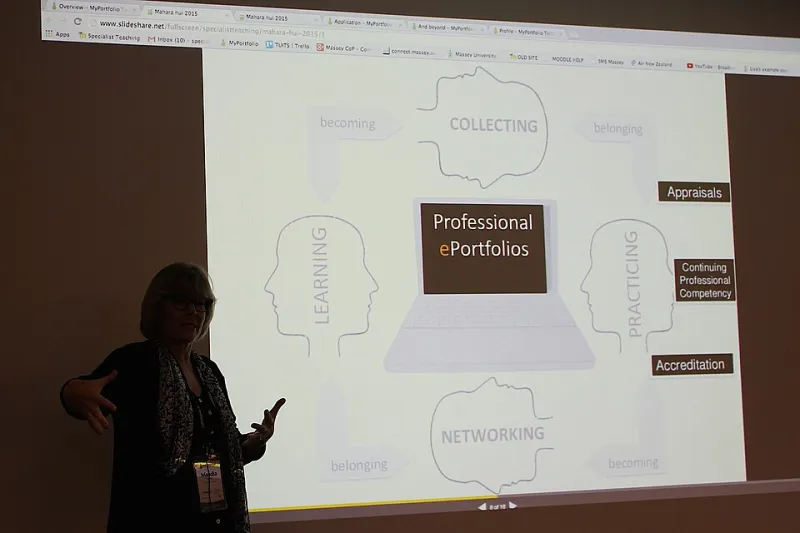
Photo: Mahara Hui New Zealand, CC BY-SA 2.0, via Wikimedia Commons
There is a frustrating irony at the heart of many professional development journeys. A person spends months—sometimes years—acquiring credentials, refining techniques, and producing work they are genuinely proud of. They assemble a portfolio, update their résumé, and begin applying. Then, almost nothing happens. The callbacks are sparse. The offers, if they come at all, reflect neither the quality of the work nor the depth of the effort behind it.
The temptation is to conclude that more skill-building is the answer. Take another course. Earn another certificate. Add another line to the résumé. But in most cases, the bottleneck is not competence—it is communication. Specifically, it is the failure to translate expertise into a format that aligns with how modern hiring decisions actually get made.
The Audience Problem Nobody Talks About
Most professionals build their portfolios for themselves, or for an idealized audience of peers who share their technical knowledge and professional vocabulary. The result is work that impresses the already-converted while leaving the people who actually control hiring decisions—recruiters, department heads, non-specialist HR professionals—without a clear understanding of why any of it matters.
Consider the difference between a data analyst who lists "proficiency in Python, SQL, and Tableau" and one who writes: "Built an automated reporting system that reduced monthly close time by 40 percent, enabling the finance team to redirect 12 hours of analyst labor toward strategic projects each month." Both candidates may have identical technical skills. Only one has made the business case for hiring them.
This is not a superficial distinction. Research into hiring behavior consistently shows that decision-makers at most organizations are not evaluating raw technical merit—they are evaluating perceived fit, demonstrated impact, and the ability to communicate value clearly. A portfolio that fails on any one of those dimensions will underperform, regardless of the quality of the underlying work.
Why Strong Work Gets Ignored
Several structural factors cause high-quality portfolios to fail in practice.
Context starvation. Many portfolios present outputs without explaining the problem that was being solved, the constraints that shaped the approach, or the results that followed. Without context, even impressive work looks like an exercise rather than evidence of professional capability.
Misaligned framing. Professionals often describe their work using the language of their discipline rather than the language of their target employer. A UX designer who leads with "conducted usability heuristic evaluations" is speaking a dialect that many hiring managers do not fluently read. Framing the same work as "identified friction points in the checkout flow that contributed to a 15 percent improvement in conversion" immediately translates into business value.
Undifferentiated presentation. When every project in a portfolio receives the same treatment—same format, same level of detail, same visual weight—there is no signal about what the professional considers their strongest, most relevant, or most distinctive work. Hiring managers, who may spend fewer than three minutes reviewing a portfolio, need clear hierarchy to know where to focus.
Audience mismatch. A portfolio built for a freelance design audience will not perform the same way in a corporate hiring context. The expectations, the vocabulary, and the decision criteria are different. Professionals who fail to customize their presentation for the specific context they are entering will consistently underperform.
Repackaging What You Already Have
The good news is that fixing a portfolio does not necessarily require producing new work. In most cases, it requires reframing the work that already exists.
Start by auditing your portfolio through the lens of the employer, not the practitioner. For each piece of work, ask three questions: What problem was being solved? What specific contribution did I make? What measurable or observable outcome resulted? If you cannot answer all three clearly, the portfolio entry is incomplete—not because the work was insufficient, but because the documentation is.
Next, prioritize ruthlessly. A portfolio with six strong, well-contextualized examples will almost always outperform one with twenty entries of varying quality and relevance. Select the work that most directly aligns with the roles you are pursuing, and invest the time to document it thoroughly.
Finally, review the language you are using. Read job postings for the positions you want and note the specific phrases, priorities, and outcomes that appear repeatedly. Then audit your portfolio copy to ensure your language reflects those priorities. This is not about gaming keyword systems—it is about demonstrating that you understand the work the way the employer understands it.
Visibility as a Professional Skill
There is a broader point worth making here. In a labor market where qualified candidates are abundant and attention is scarce, the ability to communicate your value clearly and compellingly is itself a professional skill—one that is as learnable and as consequential as any technical capability.
Professionals who master this skill do not simply get more job offers. They command higher salaries, earn faster promotions, and build reputations that generate opportunities without active searching. Visibility, in this sense, is not vanity—it is strategy.
At Masterman School, we work with adult learners who are serious about advancing their careers, not just adding credentials to a list. That means helping professionals understand not only how to build skills, but how to present them in ways that actually move the needle. Because the most sophisticated competency in the world has no professional value if the people who need to recognize it never do.
Where to Start This Week
If your portfolio has not been generating the response you expected, begin with a single, focused audit. Choose your three strongest portfolio pieces and rewrite the descriptions using the problem-contribution-outcome framework described above. Share the revised versions with a trusted colleague who works outside your immediate specialty and ask them to explain back to you what you do and why it matters. If they struggle, the framing still needs work.
Small adjustments to how your work is presented can produce disproportionate results. The expertise is already there. The task now is making sure the right people can see it.