What the Professional Kitchen Knows About Teaching Adults That the University Forgot
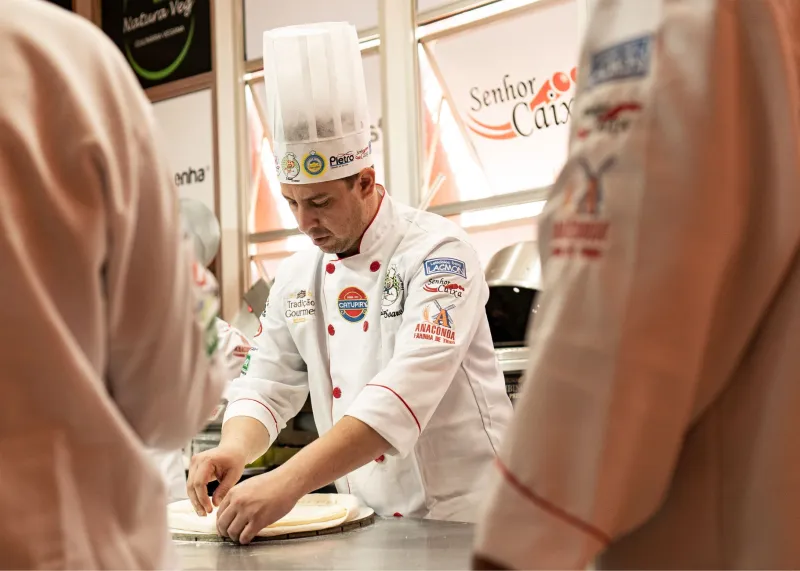
Somewhere in Providence, a thirty-six-year-old accountant is plating her first scallop dish after eleven weeks of culinary school. She has never taken a final exam. She has not written a term paper. And yet by the end of her program, she will be able to execute under pressure, accept brutal feedback in real time, and reproduce a dish to spec without hesitation. Most American universities would struggle to make the same claim about a semester of graduate coursework.
This is not a romantic observation about food. It is an argument about method. The professional kitchen—often dismissed as a place of sweat and shouting—runs one of the most sophisticated adult learning systems in the country. And for working professionals trying to build new skills in data analysis, writing, or design, it may be the most underused model available.
Mise en Place: Preparation as a Learning Discipline
Every culinary student learns mise en place—"everything in its place"—before they learn to cook. Ingredients are measured, tools are staged, stations are organized before a single flame is lit.
Most adult learners do the opposite. They open a video course on Python or UX design with no defined workspace, no planned practice session, and no idea what they intend to produce. The result is the familiar pattern of abandoned coursework that plagues online education, where completion rates for massive open online courses have historically hovered in the single digits.
Applying mise en place to professional learning means deciding, before you begin: What specific output will this study session produce? What tools and references will be within arm's reach? What does "done" look like? A data analyst in training might stage a dataset, a notebook, and a single well-defined question—forecast this quarter's numbers—before sitting down. The discipline is not glamorous, but it is the difference between sessions that compound and sessions that evaporate.
Station Rotation: Learning by Doing Everything Badly, Once
Culinary programs rotate students through stations—garde manger, sauté, pastry, grill—on a fixed schedule. Nobody gets to camp out where they are comfortable. The pastry-inclined student still works the grill; the grill enthusiast still decorates cakes.
Compare this to how professionals typically learn, which is to gravitate toward the parts of a skill they already enjoy. The aspiring designer perfects typography for months while avoiding anything resembling user research. The would-be analyst masters spreadsheet formatting and quietly dodges statistics.
The station model imposes breadth before comfort. A self-directed learner might adopt it directly: assign yourself rotations—say, four weeks each of data cleaning, visualization, statistical reasoning, and communication of results—and move on schedule whether or not you feel ready. The kitchen's insight is that early exposure to your weakest station is not a detour from mastery. It is mastery, arriving on time instead of never.
The Chef's Table Critique: Feedback at the Speed of Work
Perhaps no feature of culinary training distinguishes it more sharply from conventional education than the critique. In most culinary programs, a chef tastes your work and evaluates it—tonight, in front of your peers, against a standard. There is no deferred grading, no rubric delivered three weeks later by someone who barely remembers the assignment.
Contrast this with the typical adult learning experience: a certificate course where assessment is a multiple-choice quiz, or a self-paced tutorial with no assessment at all. The feedback loop is so long it might as well not exist.
Professionals rebuilding their skills can reconstruct this loop without enrolling anywhere. Three practices approximate it:
- Ship small and often. A single dashboard, a 600-word analysis memo, one redesigned screen—released weekly, not quarterly.
- Recruit a palate you trust. One experienced practitioner willing to review your work against a professional standard, in writing, within days.
- Critique the work, not the person—and insist others do the same. Culinary critiques target the dish: seasoning, temperature, presentation. Adopting that framing lowers the emotional cost of hearing hard things.
The speed of feedback, not its severity, is what matters. A competent critique delivered within 48 hours outperforms a brilliant critique delivered within a month.
Why This Model Suits Working Adults
The deeper argument is structural. University education was largely designed around the rhythms of eighteen-year-olds: long semesters, deferred consequences, assessment as an endpoint. The kitchen was designed around adults with jobs—people who needed competence quickly, who learned best with their hands, who could not afford to wait until the end of a term to find out whether they were any good.
That describes nearly everyone trying to upskill in 2025. The account manager studying analytics, the marketing coordinator learning to write data-driven copy, the administrative professional teaching herself design tools—these learners do not need more content. The content is abundant and largely free. What they need is a training architecture: preparation rituals, forced rotations, and fast, honest critique.
Building Your Own Kitchen
Start with a single skill and a ninety-day horizon. Write down your stations—the four or five sub-skills that make up the whole. Schedule your rotations. Define your mise en place ritual for each practice session. Then find, or manufacture, your chef's table: a mentor, a peer group, a local meetup, even a demanding client who will tell you the dish needs salt.
Culinary schools figured out long ago what much of the education industry is still discovering: adults do not learn by accumulating information. They learn by doing real work, in front of people who will tell them the truth, on a schedule that does not tolerate avoidance. The best classroom in America may indeed have a stove in it—but its principles will fit just as easily on a laptop.